We have landed ! 14/7/2008

Tribute to Navarana Freuchen

Peter Freuchen was a Danish explorer who lived among the the Polar Inuit (Eskimo) in Greenland for most of his adult life, in the late 1800's and early 1900's when the arctic hardly knew the influences of the white man.

Update 13.07.08
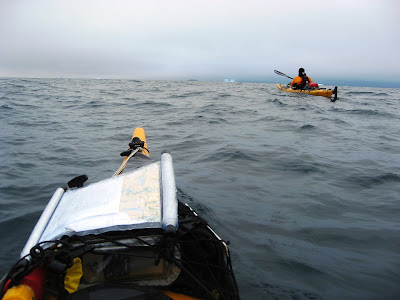
Very strong winds
Wind calmed in the night
We left our camp at 2am and paddled till 9 am
we are now about 1-1.5 days paddle from Upernavik.
There are lots of harp seals in the area and birds colonies
Updates are Received By Satellite Phone and are updated by tal shani
Weather Support is Provided By Karel Vissel
Update 12.07.08
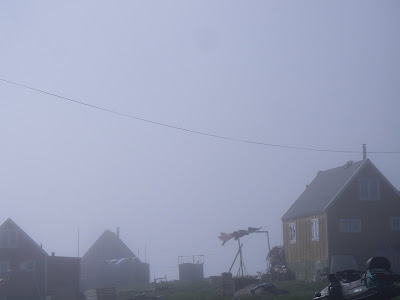
We passed thru "Sondre Upernavik" village today. The most remote southern village in the area.
We got some supply, the village people were very freindly and helpfull
We are most of the time in open sea, there are strong winds up to force 6 We had to land early due to strong head winds We are heading north to upernavik
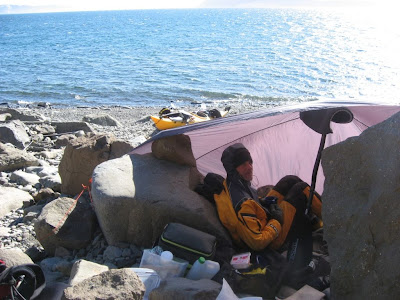
Update 11.07.08

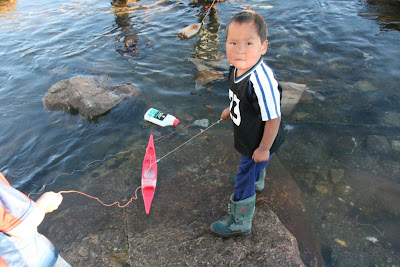
people very friendly and the kids were very helpfull with the kayaks.
Now AT 72 20N 55 09W
going to circle qeqertaq island clock-wise
Weather Support is Provided By Karel Vissel

Update 08.07.08

YESTERDAY WE HAD 2 GRILED ARCTIC TROUTS !!
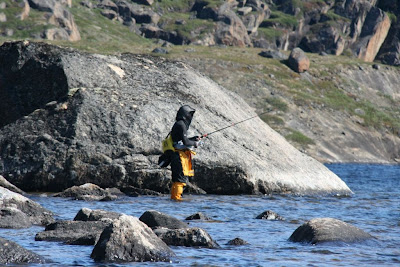
Kayak anxiety
 There have been reports of a peculiar sea and atmospheric condition which is characterized by a very calm sea with fog that has an adverse physiological effect on paddlers:
In 1963, scientists described a phobic like syndrome, "Kayak-angst", as it appeared in West Greenland.
The study was published in the: "Int J Soc Psychiatry" According to the study, it is an irrational sudden anxiety, dizziness and fear of dying -- while paddeling in placid sea.
It occurs mainly in foggy conditions, with calm seas, on open water. The kayaker can't distinguish the horizon and loses the ability to determine up from down.
Update 07.07.08

We are AT 72 29N 54 28W This area is called J.P.Kochs Land and it is part of Greenland mainland.
This area enjoy from a relative warm weather and we heard that even tiny trees can be found in this area.
will stay here 2-3 days exploring area
looking for musk-ox, salmons .
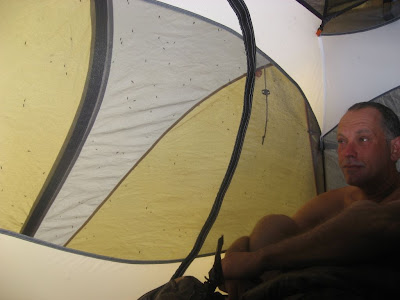
It is arctic summer and the mosquitoes are all around but we are trying to ignore them
Updates are Received By Satellite Phone and are updated by tal shani
update 06.07.08

We joined a local on a hunting & fishing trip
We caught many fish but no seals (Lucky them).
Anyway, I must admit that seal meat is very tasty !
Our local host Bent Petersen and his family are great ! and it was nice to make shower at last and to sleep on real beds
Updates are Received By Satellite Phone and are updated by tal shani

update 03.07.08

we are in Aappilattoq village
population : 208
N 72° 53' 0'' W 55° 36' 0''
We are on the internet for the first time just for short time
thank you very much Tal for updating our blog you do a gret job !
thanks karel for the weather updates ! tommorow we are going with a local hunter for seal hunting
We will be sleeping this night in his village and will have a shower !!!!
the weather got much better the last couple of days but the warming brought the mosquitos
: milions of them! but we fighting back!
alan and kobi
Updates are Received By Satellite Phone and are updated by tal shani
Updates are Received By Satellite Phone and are updated by tal shani
Update 02.07.08

It Is Freezing up here no global warming right now.
we navigate in heavy fog - its a real challenge !!!!
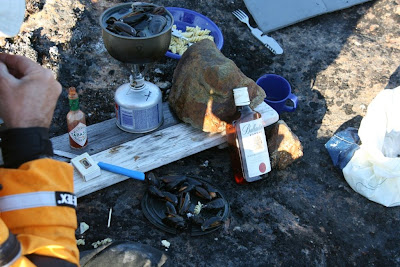
Eating cod fish & mussels & and a lot of pasta but we start to ran out of whisky !
73 09N 55 53W foggy,cold but winds moderate in line with karel's forecasts.
kobi and alan
Updates are Received By Satellite Phone and are updated by tal shani
01.07.08 Update
Now about 10km NW of Tasiusaq
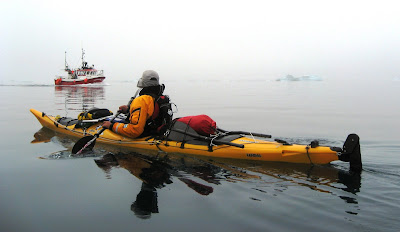
Update 30.06.08

yesterday in Naajat : a small inuit settelment local hunter had a short paddle with Alen kayak :he did OK! - The first introduction kayak session of Terrs-Santa in Greenland
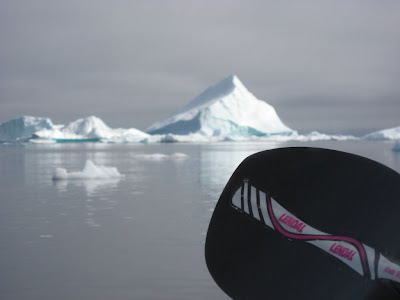
Update 28.06.08

strong head winds but dry and sunny.
heading to a Kuk setlement, we dont know if it is habitant
we are going to cross a very icy fjord now
Updates are Received By Satellite Phone and are updated by tal shani
Update 27.06.08

HI ALL
Position 74 28N 57 16W
Thunder of breaking ice bergs every few minutes
We are sout of Nuussuaq vilage
We were invited there for coffee and whale meat
Great view and great people (Thanks Peter!)
Updates are Received By Satellite Phone and are updated by tal shani

Peter Reimer Kristensen and Alam Brook in Nuussuaq
22.06.08 Update
 HI ALL
21.06.08 Update
 We arrived by helicopter to Kullorsuaq the northmost settlement.
After packing all the gear went up north .
The weather is goot the landscape is fantastic

arrival

we allready visited the local small hospital and they offer kobi a job here !
the weather is fine very cold but sunny

Tomorrow we will fly with the helicopter up north
Off We Go !

Our Gear
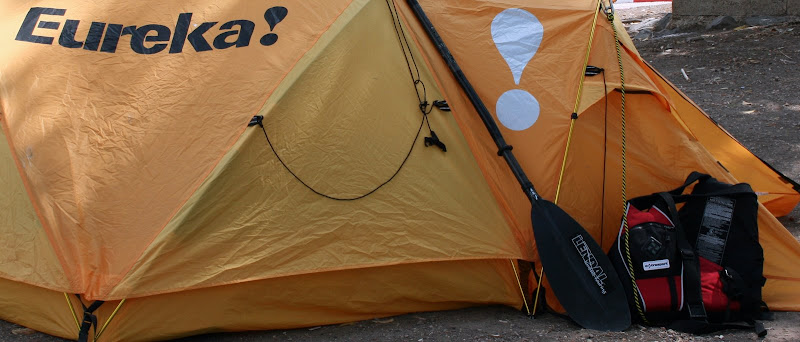
Navigation and Safety gear :
PFDs: Extrasport (c) Pro creeker (Extrasport)
Paddle float
Towing system
Satellite Phone (Iridum)
PLB
VHF
Rifle
Various Cord / Rope
Multi Tool and repair kit
GPS x 2
Deck compass x2
hand held compass x2
barometer
Maps with water proof cases
Survival Kit and First aid
Photographic equipment:
D-SLR camera: Cannon EOS 400D with 18-200mm OS lenses
Digital Water proof small camera (Pentax optio 6)
Video Camera (Panasonic)
Spares batteries
Extra memory card, Back up Memory stick and Data copier
Solar Panels
Clothing and Camping gear
Tent: K2 eureka 4 season, geodesic dome tent (Eureka!)
sleeping bags
sleeping mats (thermarest)
Gore-Tex Dry suit (Kokatat)
Fleece and Thermal Underwear and tops
Gloves and poggies
Shoes and water proof socks
Warm hats
Sunglasses
Personal stuff
Dry bags
Cooking equipment
Fuel (95% Alcohol)
Fishing Gear
Our paddles

Equipment: The Kayaks
 Optimistic Paddler with his gear (Harel Ofir, Alaska, 2005)
The Kayaks
Among the most important items are the kayak and the paddles. Back home we are happy owners of NDK Explorer and NDK Greenlander kayaks.
In previous expeditions, Kobi mainly used the NDK Explorer while Alan mostly opted for the logistic independence afforded by Feathercraft folding kayaks.
Due to the remoteness of the region and limited possibilities of transporting kayaks, we were initially considering also using Feathercraft kayaks for this trip. While this choice would have afforded maximum route flexibility, we were concerned about transport logistics and costs since we have 6 flights just to the starting point.
When we learnt of the possibility using almost new Prijon Seayak that could be delivered to our starting location, we decided to adopt this option. While this Seayak is a bit slower and has hatches that are probably less sealed than the kayaks we normally use, we consider these as fairly minor drawbacks. Our trip is mainly of an exploratory nature and not a race to cover a predefined distance in a minimal time. We will compensate for the lack of day hatches by using low profile deck bags.
Prijon seayak are made of High Performance Thermoplast Polyethylene so they should be very durable on the ice and rocky shore.
Nanook Of The North and his Kayak
This an fantastic scene from the classic film "Nanook of the North" by Robert Flaherty. The film was shot in 1922 and documents the life of Nanook, an Inuit hunter and his family as they struggle to survive in the harsh conditions of the arctic region. "Nanook of the North" is considered to be the first documentary ever made and is a truly joyous film experience
Melville Bay: The first leg of our journey
 The southern part of Melville Bay
Melville Bay which is called in Greenlandic Qimusseriarsuaq (meaning "the great dog sledding") is a large, mostly ice covered area which lies north of Kullorsuaq extending up to the Thule district.
This bay is covered with frozen sea and many tidal calving glaciers with only small scattered pieces of land. This lack of firm ground isolated the polar Inuit from the rest of western Greenland till as recently as 100-120 years ago. For that reason the polar Inuit are more closely related to the Canadian Inuit and have their own dialect, which differs significantly from that of southern Greenland.
The area of Melville Bay is isolated and totally unpopulated and we still trying to find reliable information on the ice and sea conditions from the perspective of sea kayakers.
In addition to all the ice, the area is often affected by windy conditions and stormy seas. However these conditions have a favorable effect ensuring a lot of long leads, or cracks in the ice, that narwhal and belugas exploit. This ice kingdom also attracts polar bears to hunt these waters all year around.
In fact, there is so much wildlife in the area that parts of the bay have been declared a nature reserve to protect the breeding populations of polar bears, belugas and narwhals.
The actual reserve, starting from approximate latitude 75deg 30min north, is off limits to expeditions except for scientific endeavors with special permits.
We will attempt to reach the southern boundary in the hope that the reserve's inhabitants, animal and ice exist unaware of the human designated limit.
The ice does not clear from Melville Bay every summer. But we hope that with local advice, good navigation, favorable sea conditions and a lot of luck we will succeed in approaching the area.
We know that currents and winds often pack the ice together forming an impenetrable barrier along the coast however these are the accepted terms and also part of the charm of arctic travel.
Introduction
In June 2008, two team members of Terra-Santa Seakayaks Club: Alan Brook and Kobi Sade will begin an unsupported sea kayaking expedition from Kullorsuaq in north-west Greenland.
Kullorsuaq, which is located almost 1000km north of the arctic circle, will be reached by helicopter flying out of Upernavik. After paddling northwards for a few days to a location where the Greenlandic icecap approaches the ocean, the two kayakers will turn south exploring a region of remote wilderness and sparse Inuit villages for a period of about 4 weeks. The paddling distance is expected be about 600 km depending on the state of the sea ice and the weather conditions.

The expedition goal
 Photo: Søren Nikolaj Sørensen
The Upernavik area
 Photo: Søren Nikolaj Sørensen
Wild life
 This area is in the high arctic climate belt containing sparse vegetation without trees.
On land we hope to see musk ox, reindeer and foxes. The very rich bird life includes ravens, various gulls, ducks, guillemots, puffins and little auks. The stretches of steep coastline support several seabird colonies, some of them considered among the largest in the world.
Perhaps the most important aspect of Greenland's wildlife is its marine life, which for thousands of years has been the foundation of the hunter culture. An estimated two million seals of various species live in Greenlandic waters. In addition, we will probably encounter Walruses and possibly a number of species of whales.
Although polar bears infrequently approach this area in the spring, we must be prepared since these largest living land carnivores can often be aggressive or curious and thus potentially dangerous to humans. As a semi-aquatic marine mammal, the polar bear has adapted for life on a combination of land, sea, and ice and is the apex predator within its range. It feeds mainly on seals, young walruses, and whales; although it will eat anything it can kill.
Since the polar bears can sustain swimming speeds of above 5 knots, which is comparable to the kayak's top speed, our deterrent options must be applicable to both the marine and land environments.
Finally, in summer, one of the smallest arctic wildlife species can often be the the most noticeable - arctic mosquitoes can be ferocious and can be a serious problem for the unprepared. We do not expect to encounter much during the initial part of the trip but will probably experience a lot more as we go south and the summer progresses. Head nets and hard-core repellents are a must.

 Posts
Posts


.jpg)


